
Finding Our Way Back to Each Other
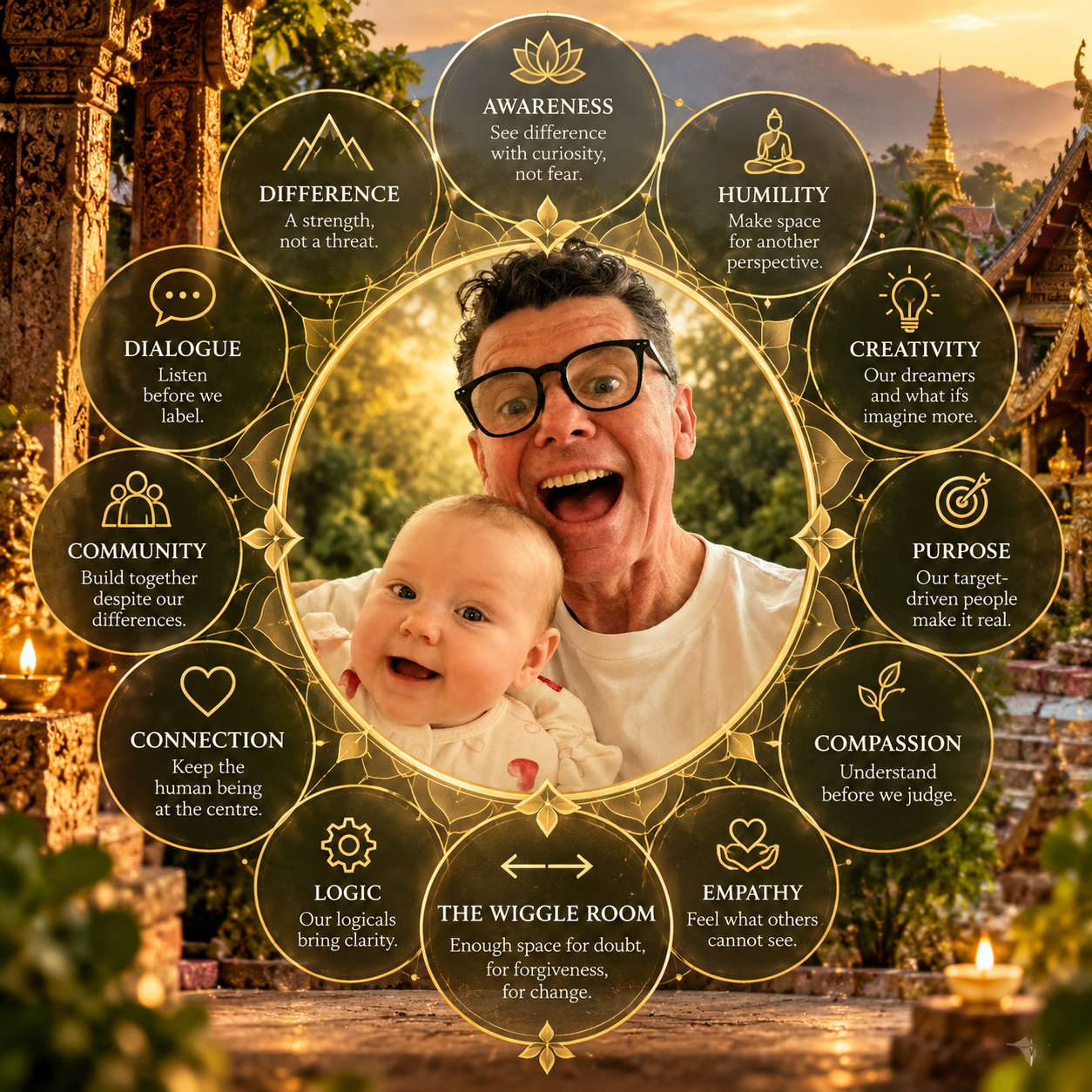
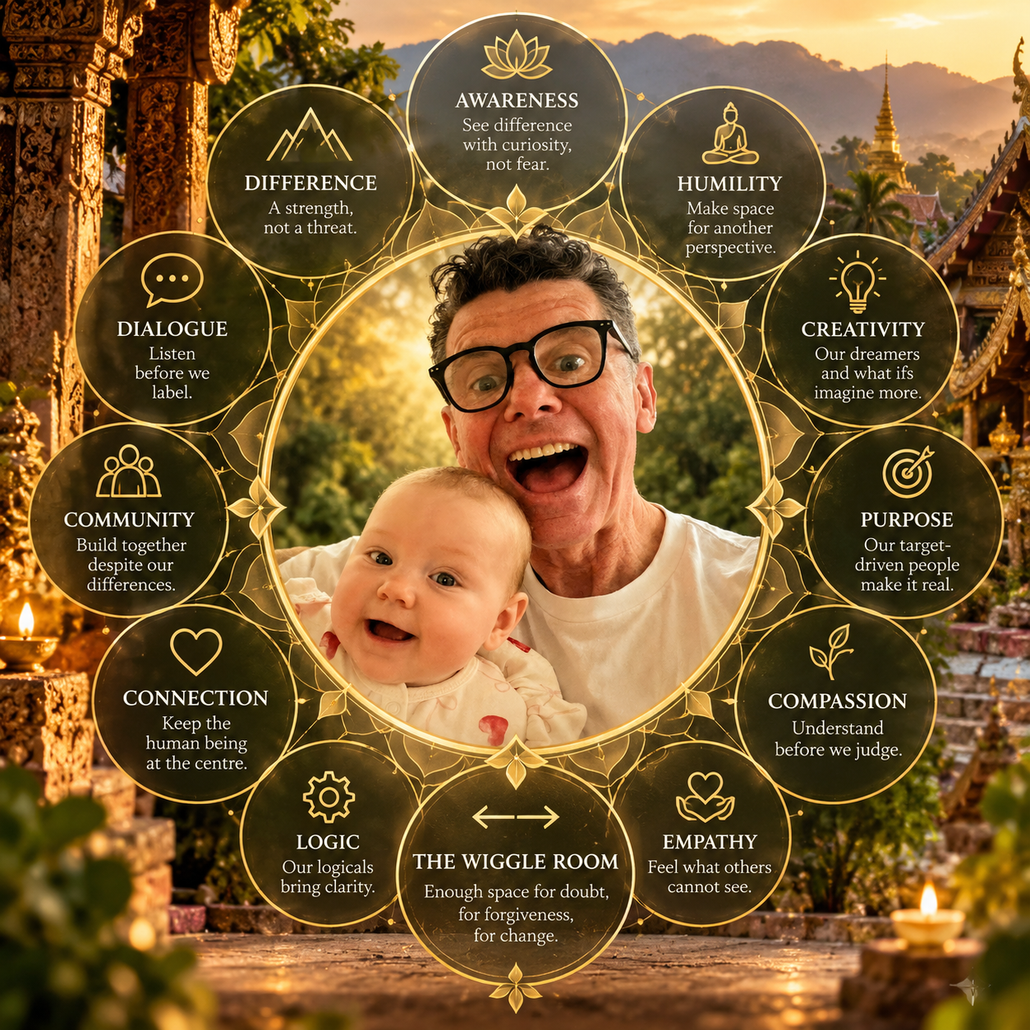
We need our obsessives as much as we need our creatives and our logical.
Our empaths and our sceptics can co-exist side by side.
I treasure my narrow-minded mates as much as they envy my open-minded cloud gazing, because sometimes the person who moves us is the person who forces the rest of us to examine why we believe what we believe.
And my Lord we all need our dreamers as much as the target-driven people who get up every morning with a destination in their heads.
Humanity has never progressed because we all thought the same way. We have progressed because somehow, imperfectly and often painfully, we found ways of living together.
Sadly though, destruction and chaos appear to be on the ascendancy and as a species we are losing the wiggle room. The contemplative middle where most sound decisions are made is narrowing.
Technology has given us extraordinary things. Knowledge that once took a lifetime to accumulate is available in seconds. Social media has connected people across continents. Artificial intelligence will change how we work, create, communicate and perhaps even understand ourselves.
Yet immediacy has come with a price. We are becoming very quick to know.
Quick to judge. Quick to respond. Quick to condemn. Quickly categorize another human being according to a sentence, a belief, a mistake, a political opinion, a photograph or something they said fifteen years ago.
The algorithms reward certainty but human beings are not certain. We are imperfect and beautifully broken. Human beings are contradictory, frightened, magnificent, selfish, loving, ridiculous creatures. We say things we regret. We believe things that later embarrass us. We hurt people we love. We change our minds. We get lost.
Sometimes, against all odds, we even find our way home.
There needs to be room for that.
There needs to be wiggle room.
When I first published One Day One Life in 2016, I was trying to understand something that had bothered me for years: how easily we confuse the trinkets we have created with life itself.
Career. Status. Money. Recognition. Achievement. Success.
Collecting pretty baubles is not necessarily a bad thing and making shitloads of money can be a noble pursuit if it is treated as a means of exchange and a source of freedom.
But anything generated by humanity is a construction and when we become completely identified with material things, something deeply divine begins to disappear.
The same thing is happening with opinion.
We are increasingly mistaking what we believe with who we are.
And once my opinion becomes my identity, disagreement becomes something much more dangerous. You are no longer questioning an idea. You are questioning me.
So, I defend myself.
I retreat into my tribe.
I find people who think like me. Algorithms helpfully send me more evidence that I am right. Your tribe does the same.
And somewhere between us, the bridge disappears.
Perhaps One Day One Life offers a very simple antidote.
Remember that we are going to die. Sounds dramatic but one day, perhaps without much warning, all our arguments, possessions, reputations, grievances and carefully constructed identities will be taken from us.
Death is the great leveler, and I have intimately experienced it with my maverick father and the gentle fading of my wonderful mother. At the end, all the success, accolades and self-renewable, term deposits mean nothing.
One day, the sun will come up without us. Gone!
And once we genuinely understand that the proposition changes.
It is no longer, am I right, but how do I live and love.
Unfortunately, at a global level we are floating in a sea of angry, passive aggressive, toxic masculinity.
We are being represented by silly old men with crooked fingers and bushy eyebrows.
It is a shame because perhaps our greatest problem is not that humanity lacks intelligence.
What we may lack is awareness and global leadership is devoid of awareness.
There is little considered space between stimulus and response – the tiny moment in which I can notice my anger before becoming my anger.
The moment when I can ask:
Why does this person annoy me?
Why do I need them to be wrong?
What if I am wrong?
And perhaps, what if neither of us is completely right?
That my friends, is the beginning of the wiggle room.
The answer then may be choosing awareness.
Eventually we must decide how we are going to walk through the world. As individuals, as a community, as a species.
That does not mean becoming passive.
Compassion is not weakness.
Forgiveness does not mean accepting cruelty, injustice or abuse. Understanding another person’s humanity does not require us to agree with their behaviour.
There are things worth opposing and there are moments when we must say no.
But there is a profound difference between opposing an idea and destroying the person who holds it.
The modern world increasingly invites us to treat disagreement as combat. Someone must win. Someone must lose. Someone must be exposed, humiliated, cancelled, defeated or silenced.
But human relationships cannot survive indefinitely as battlefields neither can communities.
So perhaps the platform for moving forward is surprisingly simple.
Connection before perfection.
A willingness to sit beside someone whose life has taken them somewhere different from ours.
Curiosity before judgement.
Listening before labelling.
Awareness before reaction and enough space for another human being to change.
A functioning community is not created by eliminating difference and building walls.
It is created by developing the emotional and spiritual capacity to hold difference without destroying connection.
Perhaps this becomes practice.
Before we post.
Before we respond.
Before we condemn.
Before we decide that another person is irredeemable.
Pause and think.
Not for long.
Just long enough to remember:
This is another human being.
They have loved someone.
They have lost someone.
They have made mistakes.
They are carrying things I cannot see.
And just like me, they are going to die.
That does not make them right.
It makes them human.
There is an enormous difference.
Maybe this is our journey of growth?
Away from certainty.
Away from the propaganda of success.
Away from the need to become somebody.
Away from the illusion that enlightenment means rising above the messy contradictions of being human.
And towards something much simpler.
Presence.
Humility.
Forgiveness.
Community.
Love.
The world does not need eight billion people who agree with each other.
It needs human beings who remember that underneath our beliefs, ambitions, fears, religions, politics, successes and failures, we share the same brief and astonishing predicament.
We arrived here.
We have very little time and then we leave.
Between those two moments is the only life we will ever know.
Our role might be to leave a bit of wiggle room.
A little room for doubt.
A little room for forgiveness.
A little room for the possibility that the person standing opposite us might know something we don’t.
A little room to change our minds.
A little room to laugh at ourselves.
A little room to be human. Because somewhere in that small space between being right and being together, we might just find our way back to each